
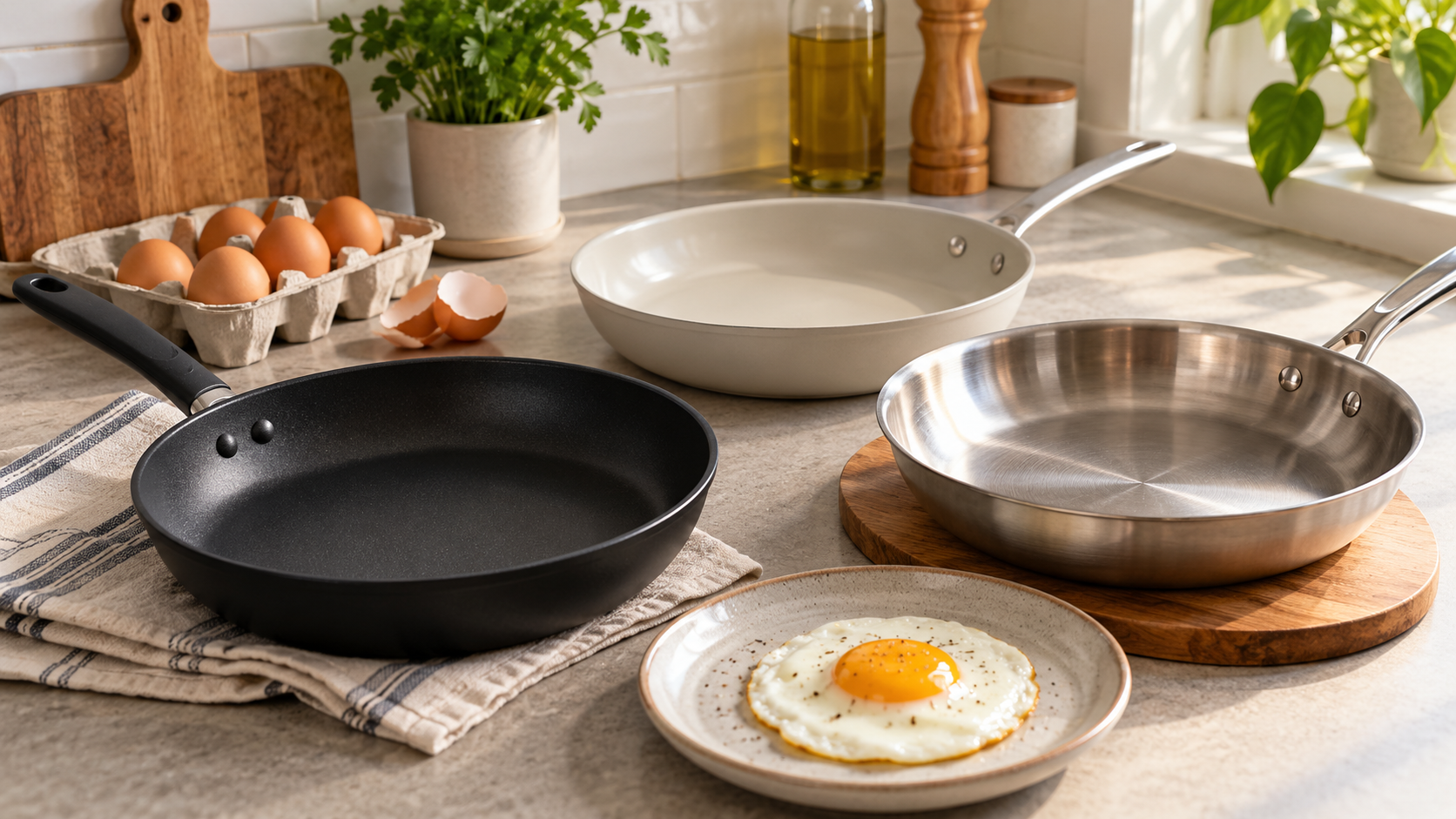
Spend a few minutes watching cookware videos online and you can come away with two completely different impressions. One person says traditional nonstick is perfectly safe. Another says a coated frying pan is exposing your family to “forever chemicals” every time you cook an egg.
The truth is more useful—and much less dramatic. There are legitimate concerns surrounding some PFAS chemicals, but that does not automatically mean normal cooking with an intact modern nonstick pan creates the same kind of exposure people hear about in PFAS headlines.
If you are shopping for a frying pan, the better question is not simply “Is nonstick toxic?” It is: What is the coating, how will I use the pan, and what tradeoffs am I comfortable with?
This guide breaks down PTFE, PFAS, PFOA and ceramic coatings in plain English, then gets to the practical part: what type of frying pan makes the most sense for the way you actually cook.
Are Nonstick Pans Toxic? The Short Answer
For modern PTFE-coated cookware used normally and kept in good condition, the available evidence does not support the idea that the pan is routinely dumping dangerous amounts of PFAS into your food.
The U.S. Food and Drug Administration says the PFAS used in authorized nonstick cookware coatings are polymerized into large molecules and tightly bound to the cookware during manufacturing. According to the FDA, studies show only a negligible amount of PFAS from these coatings is capable of migrating into food.
That does not mean every concern about PFAS is imaginary. PFAS are a very large family of chemicals, some of which are persistent in the environment and have been associated with health concerns. It does mean that “PFAS can be harmful” and “your intact frying pan is poisoning your food” are not the same claim.
There is also one situation where traditional PTFE nonstick deserves extra caution: very high heat.
PTFE, Teflon, PFAS and PFOA Are Not the Same Thing
A lot of cookware confusion starts because these terms are used as if they all mean the same thing.
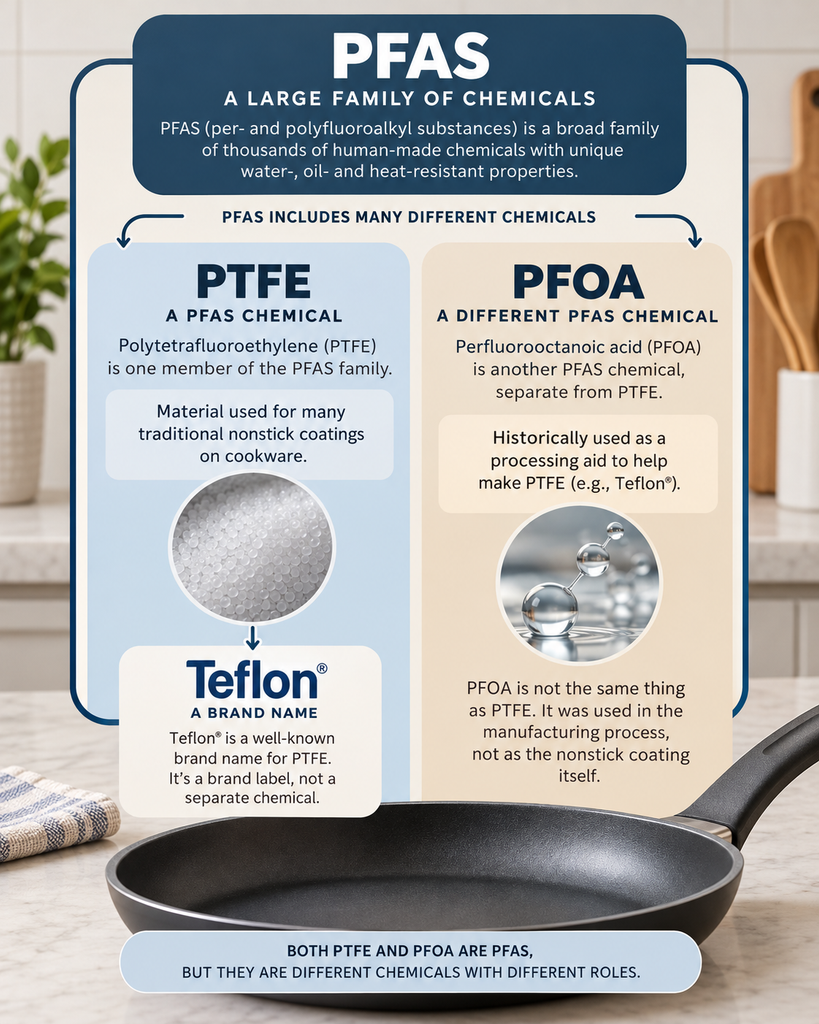
- PFAS is a broad family containing thousands of fluorinated chemicals.
- PTFE, or polytetrafluoroethylene, is the slippery fluoropolymer widely used in traditional nonstick cookware. PTFE falls within the broad PFAS family.
- Teflon is a well-known brand name associated with PTFE. It is not a separate category of cookware chemistry.
- PFOA is another PFAS chemical that was historically used as a processing aid in producing fluoropolymers, including PTFE.
The distinction matters because a pan labeled “PFOA-free” can still contain PTFE.
The EPA’s PFOA Stewardship Program pushed eight major participating companies to work toward eliminating PFOA from emissions and product content by 2015, and the EPA says those companies met the program goals. But “PFOA-free” is not the same as “PFAS-free.”
What Does “PFOA-Free” Actually Tell You?
Less than many shoppers assume.
If your goal is specifically to avoid PTFE or fluorinated nonstick coatings, a “PFOA-free” label is not enough. Look for language that clearly says PTFE-free or PFAS-free, and check what material actually creates the nonstick surface.
This is one reason vague marketing terms such as “healthy,” “clean,” “eco,” or “non-toxic” are not especially helpful on their own. The actual coating material tells you far more than the front-of-box buzzwords.
The Real Heat Concern With Traditional Nonstick
Traditional PTFE nonstick is best suited to low and moderate cooking temperatures—the exact conditions where you are likely to use it for eggs, pancakes, crepes, tofu or delicate fish.
Poison Control notes that PTFE coatings can begin breaking down when exposed to temperatures above about 500°F, releasing fumes that can cause a temporary flu-like illness known as polymer fume fever. Birds are especially sensitive to these fumes.
That makes an empty nonstick pan sitting over a burner on high heat a bad combination. Broiling and very high-heat searing are also jobs better handled by stainless steel, cast iron or carbon steel.
For normal nonstick cooking, you usually do not need that much heat anyway.
What About Scratched or Peeling Nonstick?
A tiny superficial mark is not a reason to panic about the meal you just ate. But a nonstick coating is a wear surface, and a heavily scratched, chipped or peeling pan is past the point where it makes sense to keep using it.
The FDA’s 2026 Food Code directs that cookware with perfluorocarbon resin coatings be used with nonscoring and nonscratching utensils and cleaning aids. Consumer testing organizations also generally recommend replacing nonstick cookware once the coating is visibly damaged.
The practical rule is simple: use wood or silicone utensils, avoid abrasive scrubbers, and replace a pan when the coating is clearly deteriorating.
Is Ceramic Nonstick Better?
Ceramic-coated cookware has become the obvious alternative for shoppers who want easy food release without PTFE.
Despite the name, most ceramic nonstick pans are not made from a solid slab of ceramic. They generally use a ceramic-like coating applied over a metal pan.
The big advantage is that many ceramic coatings are made without PTFE. If avoiding PTFE is important to you, that makes ceramic a straightforward option—but check the manufacturer’s actual claims rather than assuming every product marketed as “ceramic” uses the same formulation.
The tradeoff is durability. Consumer Reports notes that ceramic coatings can have excellent nonstick performance but generally do not maintain that slick surface as long as properly cared-for PTFE coatings.
So ceramic is not automatically “better.” It is a different compromise.
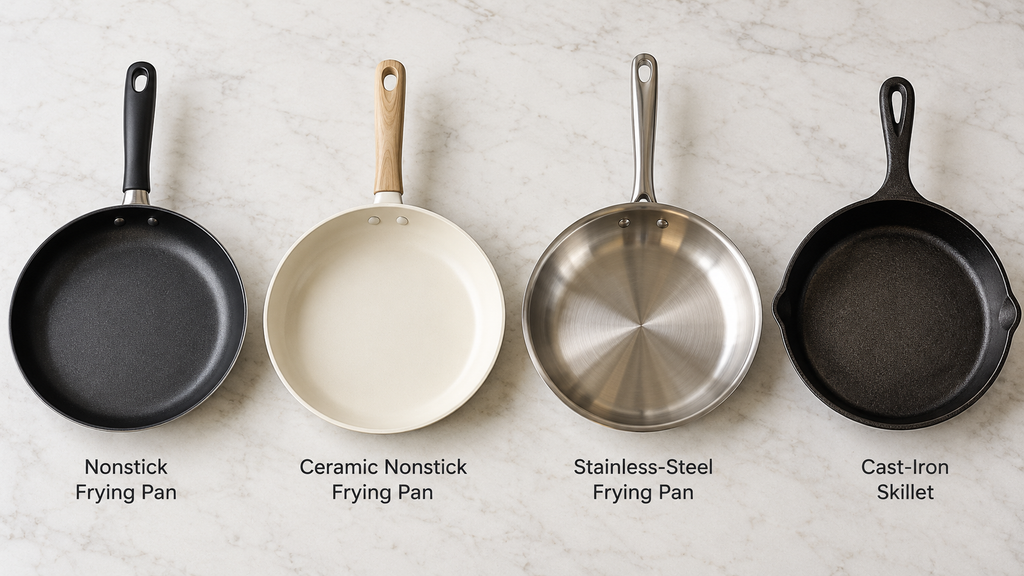
Traditional Nonstick vs. Ceramic vs. Uncoated Pans
| Pan Type | Best For | Main Advantage | Main Tradeoff |
|---|---|---|---|
| PTFE nonstick | Eggs, pancakes, delicate foods | Excellent release and easy cleanup | Coating eventually wears; avoid very high heat |
| Ceramic nonstick | Shoppers wanting PTFE-free nonstick | Slick surface without PTFE | Nonstick performance may fade sooner |
| Stainless steel | Browning, sauces, high-heat cooking | Durable and coating-free | Requires more technique to prevent sticking |
| Cast iron / carbon steel | Searing and high heat | Very durable; develops natural release with seasoning | Heavier or requires seasoning and maintenance |
If you want the easiest possible release for eggs and similar foods and are comfortable following the manufacturer’s heat and care instructions, traditional PTFE nonstick remains extremely effective.
If you want to avoid PTFE as a personal preference, ceramic is the closest substitute for the familiar nonstick experience.
If your priority is longevity, high-heat performance and avoiding a synthetic nonstick coating altogether, stainless steel, cast iron or carbon steel may make more sense.
You Probably Don’t Need a Full Nonstick Cookware Set
For many kitchens, one good nonstick frying pan is enough.
Use it for foods that genuinely benefit from an easy-release coating. Use stainless steel, cast iron or carbon steel for hard searing, very high heat and jobs where a nonstick surface adds little value.
That approach can save money because coated cookware is not generally a lifetime purchase. When the cooking surface eventually wears out, replacing one frying pan hurts a lot less than replacing an entire matching set.
10-Inch or 12-Inch Nonstick Frying Pan?
A 10-inch frying pan is compact, easy to handle and usually plenty for one or two people, a couple of eggs, smaller portions and quick breakfast cooking.
A 12-inch frying pan gives you more usable cooking area and is usually the more versatile choice for families or anyone who regularly cooks several portions at once.
If you are buying only one nonstick frying pan for a family kitchen, the 12-inch size is usually the safer bet. Just make sure the base is not so oversized that it extends far beyond the burner you use most often.
Don’t Forget Induction Compatibility
Many nonstick pans use aluminum because it conducts heat well, but plain aluminum is not magnetic and will not work by itself on an induction cooktop.
Manufacturers can make an aluminum nonstick pan induction-compatible by adding a magnetic base. If you cook on induction, look specifically for induction-compatible cookware instead of assuming every nonstick pan will work.
For cookware you already own, a simple magnet test is useful: if a magnet sticks firmly to the bottom, the pan will generally work with induction.
What to Look for Before Buying a Nonstick Frying Pan
- Know what the coating actually is. Look for PTFE, ceramic, PTFE-free or PFAS-free rather than relying only on words such as “healthy” or “non-toxic.”
- Pick the right size. Ten inches is convenient for smaller meals; 12 inches is usually more useful for a family.
- Check your cooktop. Induction users need a compatible magnetic base.
- Check the oven-safe temperature. The coating may tolerate one temperature while the handle or lid has a lower limit.
- Look for a substantial, flat base. Extremely thin pans can heat unevenly and are more prone to warping.
- Consider replacement cost. Because any coated surface eventually wears, an excellent $40–$80 pan may make more sense than treating a very expensive nonstick pan as a lifetime purchase.
- Read the care instructions before buying. A good manufacturer should clearly explain heat limits, utensil recommendations, cleaning and whether the pan is dishwasher-safe.
How to Make a Nonstick Pan Last Longer
- Use low to medium heat for most cooking.
- Do not leave an empty pan heating unattended.
- Use silicone, wood or other non-scratching utensils.
- Hand-wash when practical, even if the pan is labeled dishwasher-safe.
- Avoid steel wool and abrasive cleaners.
- Do not stack heavy pans directly on the coating without a protector.
- Replace the pan if the coating becomes badly scratched, chipped or starts peeling.
So Should You Avoid Traditional Nonstick?
You do not need to make the decision out of fear.
The FDA says authorized polymerized nonstick cookware coatings have negligible PFAS migration into food. That is a much more specific question than whether some PFAS chemicals, in some exposures, can pose health or environmental risks.
At the same time, choosing to reduce your use of PFAS-containing products is a reasonable personal preference. If that matters to you, ceramic, stainless steel, cast iron and carbon steel give you plenty of alternatives.
The practical middle ground is simple: understand what your cookware is made from, don’t overheat coated pans, replace damaged coatings, and use different pans for the jobs they handle best.
You may discover that the best setup is not choosing one side of the internet’s “nonstick is safe” versus “nonstick is toxic” argument at all.
It may just be owning one good nonstick pan for the foods that need it—and using something else when they don’t.
That’s worth one more search before you buy.
Frequently Asked Questions
Is Teflon the same thing as PFAS?
Teflon is a brand associated with PTFE. PTFE is a fluoropolymer that falls within the broad PFAS family. PFAS is the much larger chemical category.
Does PFOA-free mean a pan is PFAS-free?
No. A pan can be PFOA-free and still use PTFE. If avoiding PTFE or PFAS is your goal, look for an explicit PTFE-free or PFAS-free claim and verify what the coating is made from.
When should I replace a nonstick pan?
Replace it when the cooking surface is badly scratched, chipped, peeling or otherwise visibly deteriorated, or when the coating no longer performs properly despite appropriate cleaning and use.
Is ceramic nonstick completely coating-free?
No. Ceramic nonstick usually still has a manufactured coating; it is simply a different type of coating from traditional PTFE nonstick. If avoiding PTFE is important to you, check the manufacturer’s material claims.
What is the best frying pan if I want no nonstick coating at all?
Stainless steel, cast iron and carbon steel are the main choices. Stainless steel is low-maintenance and versatile, while cast iron and carbon steel can develop increasingly slick seasoned surfaces with use.