
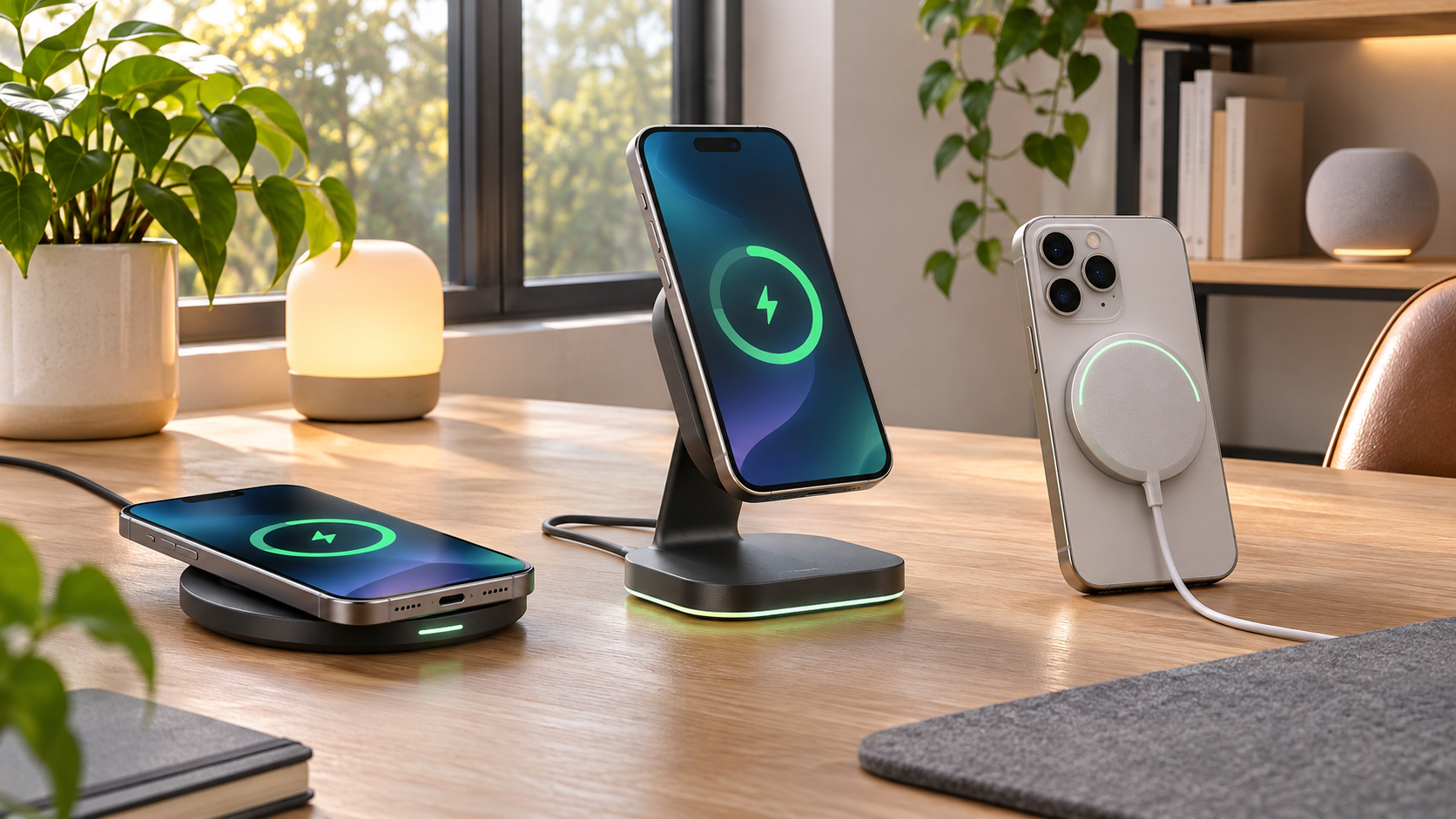
Wireless charging used to be simple: put your phone on a pad and hope it lined up well enough to charge.
Now the box might say Qi, Qi2, Qi2 25W, MagSafe, magnetic, 15W, 25W, or “compatible with” one of those standards.
Those labels do not all mean the same thing.
And in 2026, buying the wrong charger can mean more than simply getting a slower charge. You may end up with weak magnetic alignment, a case that blocks charging, a charger that technically works but cannot reach the advertised speed, or a power adapter that quietly limits the entire setup.
This guide explains the practical differences between Qi, Qi2 and MagSafe so you can choose the right wireless charger without paying for features your phone cannot use.
The Short Version: Qi vs Qi2 vs MagSafe
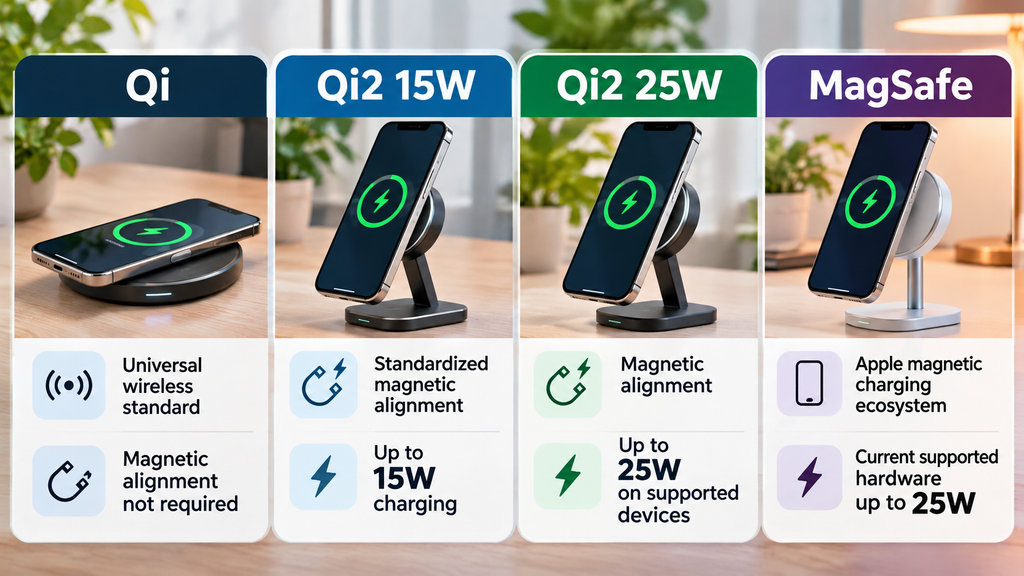
- Qi: the long-running universal wireless-charging standard. It works with a huge range of phones and accessories, but many older Qi setups rely on manual alignment and may charge more slowly.
- Qi2: the newer Qi generation that introduced standardized magnetic alignment through the Magnetic Power Profile and originally supported up to 15W.
- Qi2 25W: the newer faster Qi2 tier launched after the original 15W version. A product needs the appropriate certification to claim this faster tier.
- MagSafe: Apple’s magnetic charging and accessory system for compatible iPhones. Current Apple MagSafe hardware can deliver up to 25W on supported iPhones when paired with the right power adapter.
Short on time? Jump to our recommended wireless chargers.
The most important shopping rule is this:
Do not assume every magnetic charger is Qi2, every Qi2 charger is 25W, or every phone can accept the charger’s maximum advertised wattage.
What Is Qi Wireless Charging?
Qi—pronounced “chee”—is the wireless-charging standard maintained by the Wireless Power Consortium.
Qi has been around since 2010 and is supported by thousands of certified products. The basic idea is interoperability: a Qi-certified phone and Qi-certified charger should be able to work together within the capabilities they both support.
Older Qi charging usually places the phone on a flat pad or stand. The charging coils need to overlap reasonably well. If the phone is too far off-center, charging may slow down, become inconsistent or stop.
That alignment problem is one of the big reasons magnetic wireless charging became so useful.
What Changed With Qi2?
Qi2 added a standardized Magnetic Power Profile. Instead of simply resting the phone somewhere over the charging coil, magnets help place the phone in the correct position.
That improves the everyday experience because alignment is repeatable. The phone snaps into place instead of requiring you to slide it around until the charging indicator appears.
The Wireless Power Consortium says the original Qi2 generation brought magnetic alignment and charging at up to 15W.
That makes Qi2 especially useful for:
- charging stands,
- magnetic car mounts,
- magnetic battery packs,
- desk chargers, and
- multi-device charging stations.
Qi2 15W and Qi2 25W Are Not the Same Thing
This is now one of the easiest wireless-charger labels to misunderstand.
The original Qi2 standard launched with charging up to 15W. The Wireless Power Consortium later introduced Qi2 25W, based on Qi specification version 2.2.1, as a faster certified tier.
So a product simply advertised as Qi2 should not automatically be treated as a 25W charger.
If 25W charging is important to you, look specifically for Qi2 25W certification and verify the charger’s specifications.
The WPC’s certified-product database can also be used to confirm whether a charger is actually certified. For current Qi2 25W products, the WPC says useful database fields include version 2.2.1, the MPP25 power profile and 25.0W potential load power.
What Is MagSafe?
MagSafe is Apple’s magnetic charging and accessory system for compatible iPhones.
Its appeal goes beyond charging. The magnetic ring also enables accessories such as stands, wallets, battery packs and car mounts to align consistently with the back of the phone.
Apple’s current MagSafe Charger can provide up to 25W peak wireless charging on supported iPhone models when used with a sufficiently powerful USB-C adapter. Older iPhone models and older MagSafe hardware may top out at lower speeds.
That is why “MagSafe compatible” by itself is not a useful speed specification. You still need to know:
- which iPhone you have,
- which MagSafe charger generation you are buying, and
- what USB-C power adapter is supplying the charger.
Is Qi2 Basically Universal MagSafe?
For shopping purposes, that is a useful way to think about part of it—but it is not literally the same product ecosystem.
Qi2 standardized the magnetic alignment concept across manufacturers. That means magnetic wireless charging is no longer limited to Apple hardware.
Google, for example, now says its Pixel 10 and newer phones—excluding the Pixel 10a—support Qi2, with magnets used to align the phone and accessory. Some newer Pixels can reach up to 25W with compatible Qi2 hardware, while others are limited to lower wireless speeds.
Other Android phones vary considerably. Some support ordinary Qi charging, some use Qi2 with the Magnetic Power Profile, and some can gain magnetic alignment through a compatible Qi2 case rather than magnets built directly into the phone.
So Android shoppers should check the exact phone model instead of assuming that “wireless charging” means native magnetic Qi2 support.
The Phone Determines the Maximum Speed Too
A 25W charger cannot force a phone to accept 25W.
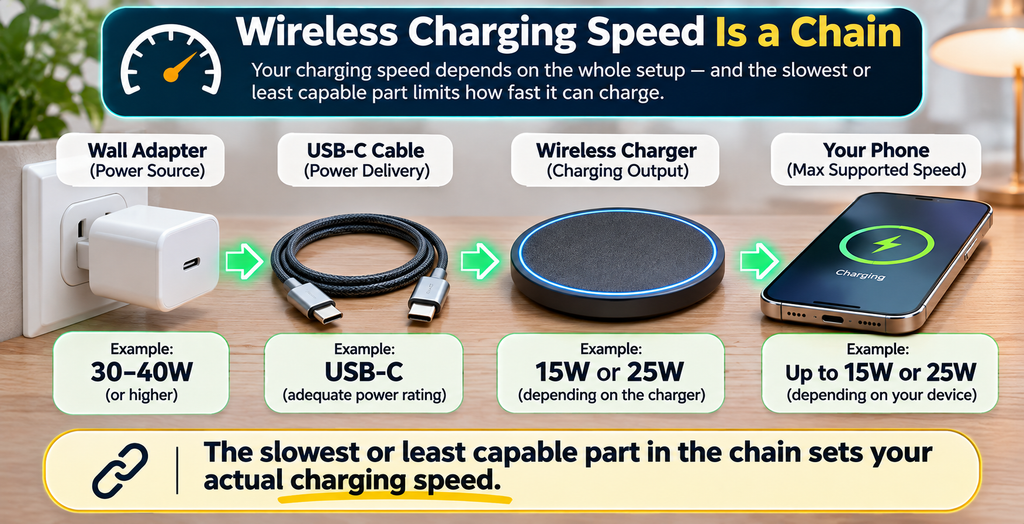
Wireless charging speed is limited by the weakest part of the chain:
- the phone’s supported wireless-charging speed,
- the charger’s supported power level,
- the power adapter feeding the charger,
- the cable connecting the adapter and charger, and
- real-world conditions such as heat and alignment.
This is why two chargers that both say “25W” on the box may not charge your phone at 25W in practice.
Your Power Adapter Can Quietly Limit the Charger
Many wireless chargers do not include a wall adapter, especially compact stands, pads and multi-device stations.
That can create a frustrating situation: you buy a charger advertised for 15W or 25W, plug it into an old low-power USB adapter, and never get anywhere near the advertised speed.
The WPC notes that many Qi2 25W charging stations require roughly a 30–40W or larger adapter to reach full output. Apple likewise specifies a 30W-or-greater compatible USB-C adapter for 25W MagSafe charging on supported iPhones.
When comparing chargers, check whether the required power adapter is:
- included,
- sold separately, or
- something you already own.
A cheaper charger is not necessarily cheaper if you immediately need to buy another USB-C adapter to unlock its advertised performance.
Does Your Phone Case Matter?
Yes—sometimes a lot.
A thick case can increase the distance between the phone and charging coil. Metal plates, ring holders and poorly positioned magnets can also interfere with charging.
For a magnetic Qi2 setup, use a case specifically designed to preserve Qi2 magnetic alignment. Google recommends removing a case if it is not Qi2 compatible and charging becomes unreliable.
Samsung similarly warns that third-party covers can create wireless-charging issues when the case does not properly support Qi2 or the Magnetic Power Profile.
This becomes especially important with magnetic car mounts because the magnet is doing two jobs at once: positioning the charging coils and physically holding the phone in place.
Heat Can Reduce Wireless Charging Speed
Wireless charging generates heat, and phones actively manage charging to protect the battery.
If the phone gets too warm, charging can slow or pause until the device cools down. Google explicitly notes this behavior for Pixel phones, and Apple also says fast charging can be limited in temperature conditions that are too hot or too cold.
This matters most in places such as:
- a car mount in direct sunlight,
- a thick insulated case,
- a charging stand beside a heat source, or
- heavy phone use while charging.
For a car charger, good alignment and airflow can matter as much as the number printed on the box.
Qi vs Qi2 vs MagSafe: Quick Comparison
| Type | Magnetic Alignment? | Typical Maximum Tier | Best For |
|---|---|---|---|
| Older Qi | Not required | Varies by device/charger | Basic universal charging and existing pads |
| Qi2 | Yes with Magnetic Power Profile | Up to 15W for original Qi2 tier | Cross-brand magnetic charging |
| Qi2 25W | Yes | Up to 25W | Newer phones that support faster certified Qi2 charging |
| Apple MagSafe | Yes | Up to 25W on supported current hardware | iPhone users wanting Apple’s magnetic ecosystem |
When an Older Qi Charger Is Still Fine
You do not need to replace every Qi pad in your house just because Qi2 exists.
An older Qi charger can still be perfectly useful when:
- you charge overnight and speed does not matter,
- the phone sits flat and aligns reliably,
- you are charging earbuds or another low-power accessory,
- your phone does not support Qi2 anyway, or
- you already own the charger and it does the job.
Google notes that older Qi chargers can still charge newer Pixel phones, although some combinations may be limited to slower speeds.
When Qi2 Is Worth Paying For
- You want magnetic alignment. The phone consistently lands in the correct charging position.
- You use a magnetic car mount. Alignment and physical attachment become part of the same system.
- You want a magnetic battery pack.
- You switch between phone brands. Qi2 offers a standardized magnetic ecosystem instead of relying entirely on one manufacturer’s proprietary solution.
- You are buying new hardware anyway. Qi2 certification gives the charger more future usefulness than an inexpensive older pad.
When Qi2 25W Is Worth Paying Extra For
Paying extra for Qi2 25W makes sense only when the rest of your setup can actually use it.
- Your phone supports a wireless speed above the original 15W Qi2 tier.
- You have—or are willing to buy—the required USB-C power adapter.
- You care about faster top-ups rather than primarily charging overnight.
- The price difference from a certified 15W charger is reasonable.
If your phone maxes out at 15W, a 25W charger may still be useful for future devices, but it will not magically make the current phone charge faster.
What to Check Before Buying a Wireless Charger
- Check your exact phone model. Do not shop based only on iPhone, Pixel or Galaxy branding.
- Find the phone’s maximum supported wireless speed.
- Decide whether magnetic alignment matters to you.
- Look for actual Qi or Qi2 certification. The WPC maintains a searchable certified-product database.
- Distinguish Qi2 from Qi2 25W. They are not the same speed tier.
- Check whether a wall adapter is included.
- Check the required adapter wattage.
- Make sure your case supports the charging system.
- For car mounts, think about heat and holding strength as well as charging speed.
- For multi-device stations, check each charging position separately. The phone, earbuds and watch spots may all support different power levels or standards.
So Which Wireless Charger Should You Buy?
If you already own an older Qi pad and mainly charge overnight, keep using it if it works reliably.
If you are buying a new charger and your phone supports magnetic Qi2, Qi2 is the better default because the magnetic alignment is genuinely useful and the standard works across manufacturers.
If your phone supports speeds above 15W and you care about faster wireless charging, look specifically for Qi2 25W rather than assuming every Qi2 product delivers that speed.
If you use a compatible iPhone and want the Apple accessory ecosystem, an official or appropriately certified MagSafe solution can still be the simplest choice.
And before buying any of them, check the power adapter and case requirements. Those two details are responsible for a lot of “this charger isn’t as fast as advertised” frustration.
The best wireless charger is not the one with the biggest wattage number on the product page.
It’s the one whose standard, magnets, power adapter and charging speed all match the phone you actually own.
That’s worth one more search before you buy.
Wireless Chargers Worth Considering
Disclosure: This section contains affiliate links. If you purchase through one of these links, One More Search may earn a commission at no additional cost to you.
Good Everyday Choice: Anker MagGo Qi2 15W Wireless Charger Stand
For a phone that supports standard Qi2 magnetic charging, this Anker MagGo stand is a strong everyday option. It supports up to 15W Qi2 charging and uses magnetic alignment to keep the phone positioned correctly while charging.
The version linked here includes both the cable and power adapter, which makes it a simpler all-in-one choice for a desk or nightstand.
Faster + Travel-Friendly Choice: UGREEN MagFlow Qi2 25W 2-in-1
If your phone supports the newer Qi2 25W standard, this UGREEN MagFlow gives you the higher charging ceiling while also folding down for travel. It can charge a compatible phone magnetically while providing a second charging spot for another device such as earbuds.
The main reason to choose this over a standard 15W Qi2 charger is if your phone can actually take advantage of faster Qi2 charging and you value the foldable 2-in-1 design.
Best for iPhone Users: Apple MagSafe Charger
If you use a compatible iPhone and want Apple’s own magnetic charging hardware, the official MagSafe Charger is the simplest option. It provides magnetic alignment and supports faster wireless charging on supported iPhones when paired with an adequate USB-C power adapter.
This is the best fit if you prefer Apple’s ecosystem and do not need a multi-device charging station.
Best Multi-Device Upgrade: Belkin Qi2 25W 3-in-1 Foldable Charging Station
If you regularly charge an iPhone, Apple Watch, and AirPods in the same place, this Belkin 3-in-1 station consolidates all three into one setup. The phone charging position supports the newer Qi2 25W standard, while the foldable design also makes it practical for travel.
It costs more than a basic single-device charger, so it makes the most sense if you will actually use the additional Apple Watch and earbuds charging positions.
Frequently Asked Questions
Is Qi2 the same as MagSafe?
No. Qi2 is an industry wireless-charging standard from the Wireless Power Consortium. MagSafe is Apple’s magnetic charging and accessory ecosystem. They share the idea of magnetic alignment, and compatible hardware can overlap, but the names are not interchangeable.
Does every Qi2 charger charge at 25W?
No. Original Qi2 products were designed for up to 15W. Qi2 25W is a newer, separately identified faster tier. Check the product’s certification and specifications.
Will a 25W wireless charger charge every phone at 25W?
No. The phone must support that wireless charging speed, and the charger also needs a sufficiently powerful adapter and compatible setup.
Can I use an old Qi charger with a newer Qi2 phone?
Often yes, because Qi2 devices retain broad Qi compatibility, but the charging speed and magnetic experience may be reduced. Always check the phone manufacturer’s compatibility guidance.
Do I need a special case for Qi2?
If you use a case, choose one designed for Qi2 or the appropriate magnetic charging system. Thick, metallic or poorly aligned cases can reduce charging performance or prevent magnetic attachment.