

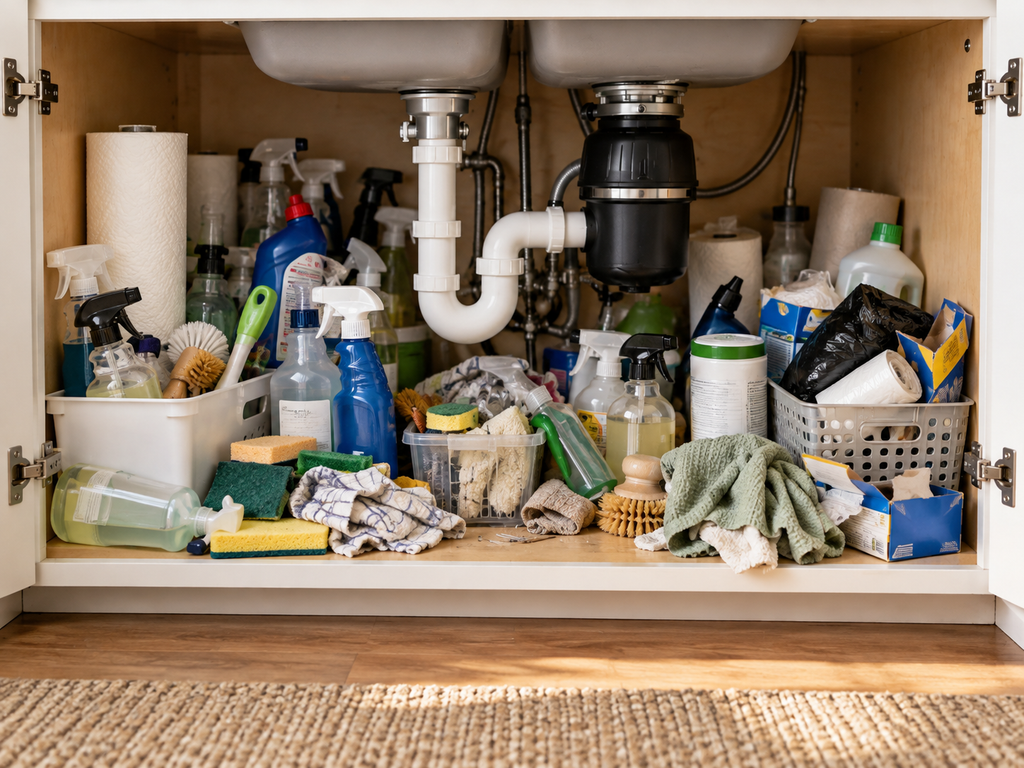
The cabinet under the sink looks roomy until you open the doors. Then you see the drainpipe, shutoff valves, maybe a garbage disposal, and a collection of bottles somehow occupying every usable inch. Good under-sink organization starts with the space you actually have—not the perfectly empty cabinets in product photos.
If you are comparing under-sink organization ideas, the goal is not to cram in the most shelves. It is to make everyday supplies easy to reach, keep the plumbing accessible, and avoid buying an organizer that cannot fit past your cabinet doors.
Here are seven approaches that solve different storage problems, with the measurements and tradeoffs worth checking before you buy.
Quick Answer: Match the Organizer to the Cabinet
For plumbing in the middle: Start with separate handled bins or an adjustable shelf that works around the pipes. For one open side: A narrow pull-out drawer can make the back of the cabinet easier to reach. For very shallow cabinets: Small caddies and slim door-mounted storage may be more useful than a tall two-tier rack.
The best setup might use only two pieces: a washable liner on the cabinet floor and one organizer that can be removed quickly. Adding more containers does not automatically create more usable storage.
First: Take Five Measurements Before Ordering Anything
Most under-sink organizers are photographed outside the cabinet or inside a staged cabinet with no awkward plumbing. Your cabinet is the one that matters. Empty it, take a picture straight on, then measure these areas:
- Door opening width. Measure the narrowest opening an organizer must pass through, not just the wider interior of the cabinet.
- Usable depth. Measure from the inside edge of the door opening to the back, leaving room for hinges, pipes and any hoses.
- Clear space beside the plumbing. Measure each side separately. The left and right sides may be very different.
- Vertical clearance. Measure from the floor up to the underside of the sink basin, plumbing, disposal or other obstacle at the exact spot where a shelf would stand.
- Pull-out clearance. If you want a sliding drawer, check that it can move forward without hitting a hinge, door, center stile or another organizer.
Make a rough sketch and mark the no-storage zone around shutoff valves, drain connections and anything you might need to inspect or service. A cabinet that shows signs of moisture—such as dampness, swelling or a musty smell—needs that issue addressed before you cover the area with bins or liners.
One More Search tip: Check the product’s assembled outside dimensions, including feet, handles and drawer rails. The storage basket itself may be smaller than the frame that has to fit inside your cabinet.
1. Removable Handled Bins: Best for Awkward Plumbing
Best for: cabinets where pipes, filters or disposals leave several small, irregular pockets of usable space.
Two or three washable bins can work better than one expensive organizer. Put frequently used items in the front bin, refills in another, and loose accessories in a third. When you need to reach a pipe or spot a leak, you can lift everything out in seconds.
Why this setup works
- No installation or drilling.
- Easy to move from a kitchen cabinet to a bathroom or utility room.
- Lets you organize around plumbing instead of forcing plumbing to fit around a rack.
- Usually easy to wipe out after a spill.
What to check before buying
Look for sturdy handles, bottoms that sit flat and bins narrow enough to clear the actual cabinet opening. A bin full of heavy bottles becomes awkward to lift, so do not choose a large container merely because it fits.
2. Narrow Pull-Out Drawer: Best When One Side Is Open
Best for: deeper cabinets with one clear lane beside the plumbing and supplies that keep disappearing into the back.
A pull-out organizer brings stored items toward the door instead of making you reach around pipes. It can be especially helpful for frequently used cleaning tools, trash bags or bathroom supplies. A single-tier pull-out is often easier to fit beneath a sink than a tall double-decker unit.
What to watch for
Test the entire motion on paper before buying: Can the frame fit through the opening? Does a door hinge intrude on the drawer? Is there a clear sliding path? If the organizer screws to the cabinet, consider whether you are comfortable making permanent holes and whether the base is sound enough for the load.
One More Search tip: If the cabinet is deep but narrow, one well-sized pull-out may be more useful than two shelves that require you to unload the front every time you need something from the back.
3. L-Shaped Two-Tier Organizer: Best for Tall Bottles and Side Plumbing
Best for: cabinets with enough open width for a lower tray, but a pipe or sink bowl that blocks part of the upper level.
An L-shaped organizer typically uses a wider bottom tier and a smaller upper tier offset to one side. That shape can leave room for plumbing while making use of space above shorter items. Some models let you position the upper shelf on either side, but not all do.
The tradeoff
This option looks efficient in photos, but the second level only helps if you can still reach its contents. Check the position of the P-trap, the height of your tallest bottle and the distance from the top shelf to the underside of the sink. If everything barely clears when empty, it may not be pleasant to use once loaded.
4. Adjustable or Split Shelving: Best for Pipes Across the Center
Best for: cabinets where a conventional shelf would collide with a pipe near the middle.
Expandable racks and modular shelves can create storage on the left and right while leaving a gap for the P-trap. Some use movable shelf panels; others combine narrow shelves. This approach makes sense when a single wide frame is too rigid for the space.
The key is to check exactly what adjusts. An expandable width does not necessarily mean the shelf depth or height changes. Look at the assembly diagram and make sure the adjustable section matches where your plumbing sits. Keep valves and joints accessible.
5. Slim Door-Mounted Rack: Best for Lightweight Daily Essentials
Best for: flat cabinet doors with unused interior surface and small, frequently used items.
A shallow door rack can hold lightweight items such as cleaning cloths, disposable gloves, small brushes or spare sponges. It frees shelf space without adding another tall unit around the pipes.
What to measure
Close the door slowly with a measuring tape or cardboard mock-up where the rack would go. Make sure it will not hit the sink bowl, stored bottles, shelves or the cabinet frame. Check the door material, the rack’s weight rating and whether a hanging or adhesive mount is actually suitable for that surface.
Avoid overloading a flimsy door. And because children can often reach low cabinets, a convenient door rack is not a suitable substitute for secure, inaccessible storage of hazardous cleaners.
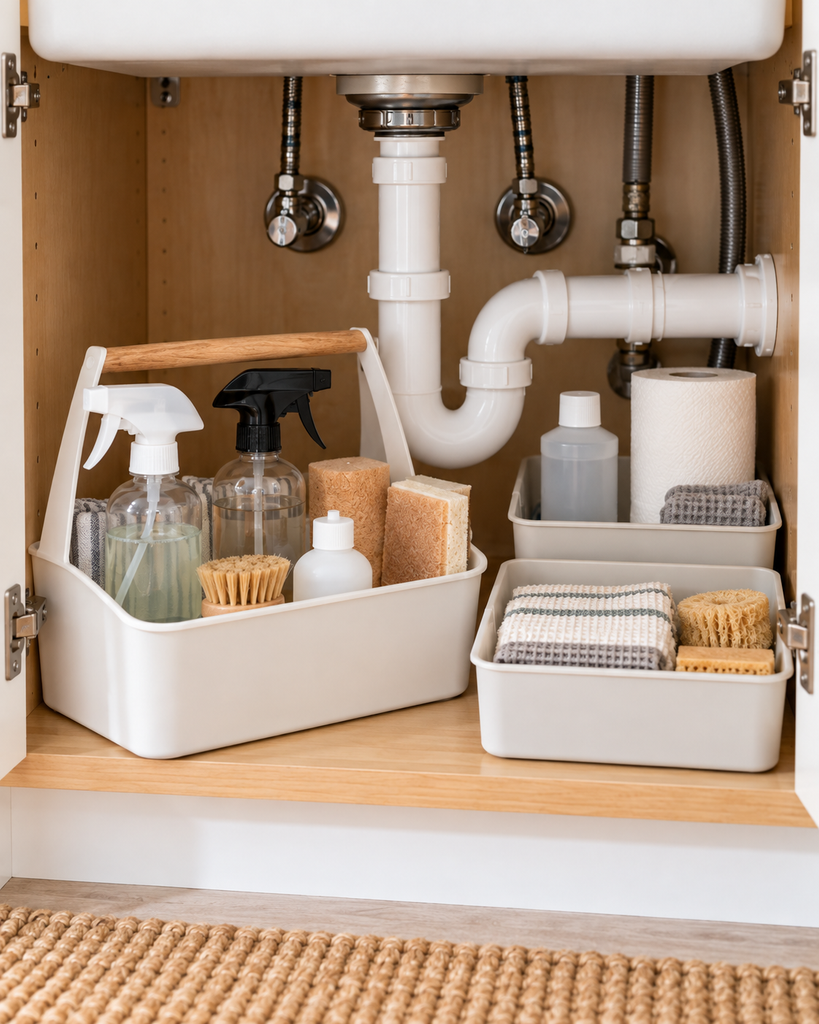
6. Portable Cleaning Caddy: Best for Supplies Used Around the House
Best for: people who routinely carry appropriate household cleaning supplies from room to room.
A handled caddy is less about stacking and more about making a routine easier. Use compartments to keep tools together and choose a stable, wipe-clean bottom that can be removed if something leaks. Store products upright and keep them in their original, clearly labeled containers.
A caddy full of cleaning chemicals should not be left where children or pets can access it, even briefly. Follow each product label’s storage instructions, and do not combine incompatible cleaners in a shared or unlabeled bottle.
7. Washable Cabinet Liner Plus Low Trays: Best for Simple, Flexible Storage
Best for: shallow cabinets, irregular layouts and anyone who wants a low-cost improvement without installing a rack.
A removable, wipe-clean liner and a few shallow trays make it easier to group supplies and see drips or spills. Choose a liner that lies flat and can be lifted out. Trays are especially useful for small items that otherwise roll to the back.
A liner is not a solution to an active plumbing leak. If the cabinet is wet or musty, stop organizing and address the moisture source first. Do not permanently cover a damp cabinet floor with a waterproof layer and hope the problem disappears.
Which Under-Sink Organizer Should You Choose?
Use the shape of your cabinet—not the number of pieces in a product listing—to narrow the options:
- Lots of pipes, disposal or filters: removable bins that can sit in separate pockets.
- One long, clear side: narrow pull-out drawer.
- Low plumbing on one side, open space above the other: L-shaped two-tier organizer.
- Pipe in the middle: adjustable or split shelving, if the gap matches your layout.
- Small loose items: shallow door rack, provided it clears the door swing.
- Supplies used in several rooms: a portable caddy.
- Very shallow or irregular cabinet: washable liner and low trays.
This is why we would not call one style the universal “best under-sink organizer.” An organizer that wins on capacity can lose on fit, access or ease of cleaning.
What Should Not Go Under the Sink?
Before organizing, make sure the cabinet is an appropriate place to store each item. Plumbing areas can be vulnerable to leaks, and lower cabinets may be accessible to children and pets.
- Cleaning chemicals within easy reach of children or pets. Store hazardous products securely, preferably out of reach, and follow their labels.
- Cleaners transferred into food or drink containers. Keep products in their original labeled packaging.
- Items easily damaged by moisture. Paper products, important documents and other moisture-sensitive supplies are often better stored elsewhere.
- Anything blocking shutoff valves or visible pipe connections. You need room to respond quickly if a fitting leaks.
Do not mix cleaning products. The American Cleaning Institute advises keeping products in original containers and storing them securely away from children and pets. The CDC specifically warns against mixing bleach with other cleaners or disinfectants.
Three Common Buying Mistakes
Buying to fit the cabinet width instead of the door opening
A rack may fit inside the cabinet but still be impossible to get through the opening. Measure the opening first.
Ignoring the way drawers move
A pull-out that clears the pipes when closed can still hit a hinge or door as it extends. Check the full path, not just the resting footprint.
Adding storage before checking for dampness
Organizers make it easy to hide a slow drip. Inspect the cabinet floor, connections and wall before loading the space, and leave room to check them again.
A 20-Minute Under-Sink Reset Without Buying Anything
Before you spend money, try this short reset. It may reveal that you only need one small bin rather than a complete storage system.
- Empty the cabinet and set aside anything that does not belong there.
- Check for moisture, visible damage and obstacles you need to keep accessible.
- Wipe and dry the interior, using appropriate cleaners as directed.
- Group everyday items, occasional refills and small accessories separately.
- Put the most-used safe-to-store items at the front, leaving plumbing access clear.
- Measure the remaining awkward space before deciding whether an organizer would improve it.
Before You Buy: The One More Search Checklist
- Have I measured the narrowest door opening, not only the inside of the cabinet?
- Do I know exactly where the pipes, valves, hinges and disposal sit?
- Will the organizer fit when assembled and loaded?
- If it slides, can it extend fully without hitting anything?
- Can I remove the contents quickly to check plumbing?
- Is the material easy to wipe down if there is a spill?
- Am I safely storing all cleaning products and other hazardous materials?
- Could fewer, simpler bins solve this problem just as well?
The Bottom Line
The most useful under-sink organization idea is the one that fits the actual cabinet and makes your routine easier. Start with measurements, choose a layout that works around the pipes, keep plumbing accessible, and avoid adding racks simply because they look impressive in photos.
For many homes, a removable bin or one narrow pull-out will be enough. Others really do benefit from a split shelf or L-shaped organizer. The right answer depends on your cabinet and what you need to store—not a one-size-fits-all shopping list.
Sources & Further Reading
- American Cleaning Institute — Cleaning Product Safety (original containers, secure storage and safe use).
- CDC — Cleaning and Disinfecting with Bleach (why cleaners should not be mixed).
- CDC — Mold (the importance of addressing moisture and leaks).
Before you buy, do one more search.