
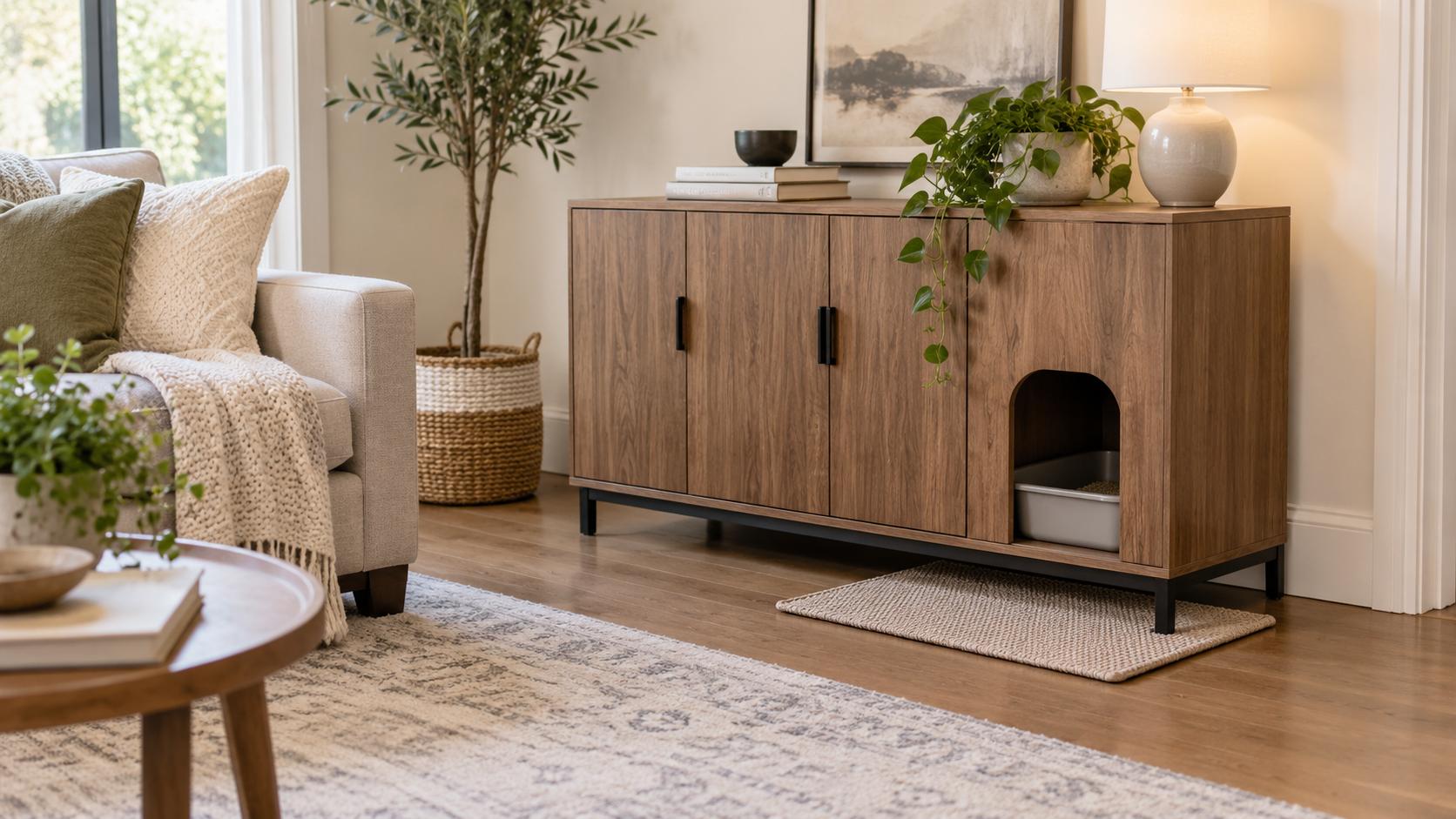
A litter box may be necessary, but it doesn’t have to be the first thing you notice when you walk into a room. Hidden litter box furniture can make a shared space look cleaner and more intentional — but the wrong setup can create a cramped, smelly space your cat doesn’t want to use.
Before buying an enclosure, it’s worth doing one more search. Below are seven ways to hide a litter box, what each setup does well, and what to check before spending your money.
Before You Hide the Litter Box: Check These First
Hidden litter box furniture only works if it still functions as a good litter box from your cat’s point of view. Before choosing a cabinet or enclosure, check these basics:
Measure the usable interior, not just the furniture. A litter box should generally be about 1.5 times the length of your cat’s body, with enough room to enter, turn around, dig and eliminate comfortably. The enclosure has to fit that box with room to spare — not force you into a smaller tray just because the cabinet looks good.
Think about access. The box should be somewhere quiet but easy for your cat to reach. Kittens, older cats and cats with mobility limitations may also need a lower entrance.
Don’t sacrifice ventilation for appearance. Many cats prefer uncovered litter boxes, and covered boxes can hold odors if they aren’t cleaned frequently. If you use furniture to conceal the box, look for good airflow and easy access for daily scooping.
For multiple cats, one cabinet usually isn’t the whole solution. A commonly recommended starting point is one litter box per cat plus one extra, preferably spread among different locations rather than all grouped together.
Pay attention to what your cat actually prefers. If your cat is hesitant about an enclosure, try offering an open box alongside it. Cats can have strong preferences about box size, cover style, litter and location.
The goal is to hide the litter box from people, not make it harder or less comfortable for the cat to use.
1. Sideboard-Style Litter Box Cabinet
Best for: living rooms, dining areas and other visible spaces
A sideboard-style enclosure is probably the easiest way to make a litter box blend into a room instead of looking like pet equipment. From the outside, it can look like an ordinary console or storage cabinet while the litter box sits behind closed doors.
The biggest advantage is appearance plus usable surface space. The top can hold normal household items, and many models include extra storage for litter, liners, scoops or other cat supplies.
Why it can work well
A wider cabinet generally gives you more flexibility than a small end-table enclosure. That matters because the furniture may look large from the outside while still losing several inches of usable interior space to walls, dividers and doors.
The better designs also make cleaning easier by giving you large front doors or another way to reach the entire litter tray without having to drag the cabinet away from the wall.
What to watch for
The biggest mistake is shopping by the outside dimensions. Always find the internal compartment measurements and compare those with the actual litter box you plan to use.
Also check:
- whether the entrance is large enough for your cat
- whether the cabinet has ventilation openings
- whether an internal divider reduces the space available for the litter tray
- whether the doors open wide enough for easy scooping and cleaning
- whether the interior material can be wiped clean if litter or urine gets outside the tray
A beautiful cabinet is not much of an upgrade if it forces you into a litter box that is too small or makes daily cleaning annoying.
One More Search tip
Measure your litter box first, then shop for the furniture — not the other way around. Add a little extra room around the tray so you are not buying an enclosure that technically fits but feels cramped once everything is inside.
2. End-Table Litter Box Enclosure
Best for: small rooms, apartments and spots where furniture needs to do double duty
An end-table style enclosure is a good option when you want to hide a litter box without giving up a lot of floor space. These usually work best beside a sofa, in a bedroom corner, or anywhere a normal side table would already make sense.
Why it can work well
The main benefit is efficiency. You get a hidden litter box plus a usable tabletop in roughly the footprint of a small piece of furniture.
They can also be easier to move or rearrange than a large sideboard-style cabinet.
What to watch for
The tradeoff is interior space. End-table enclosures are often compact, so they are more likely to force you into a smaller litter tray.
Check:
- the inside dimensions, not just the outside measurements
- whether your cat has enough room to turn comfortably
- whether the entrance is too narrow or high
- whether the top can handle the weight of whatever you plan to place on it
- how easily the enclosure opens for scooping and full cleaning
One More Search tip
If the enclosure saves space but forces you into a litter box your cat dislikes, it isn’t really saving you anything. Prioritize usable interior room over the smallest possible footprint.
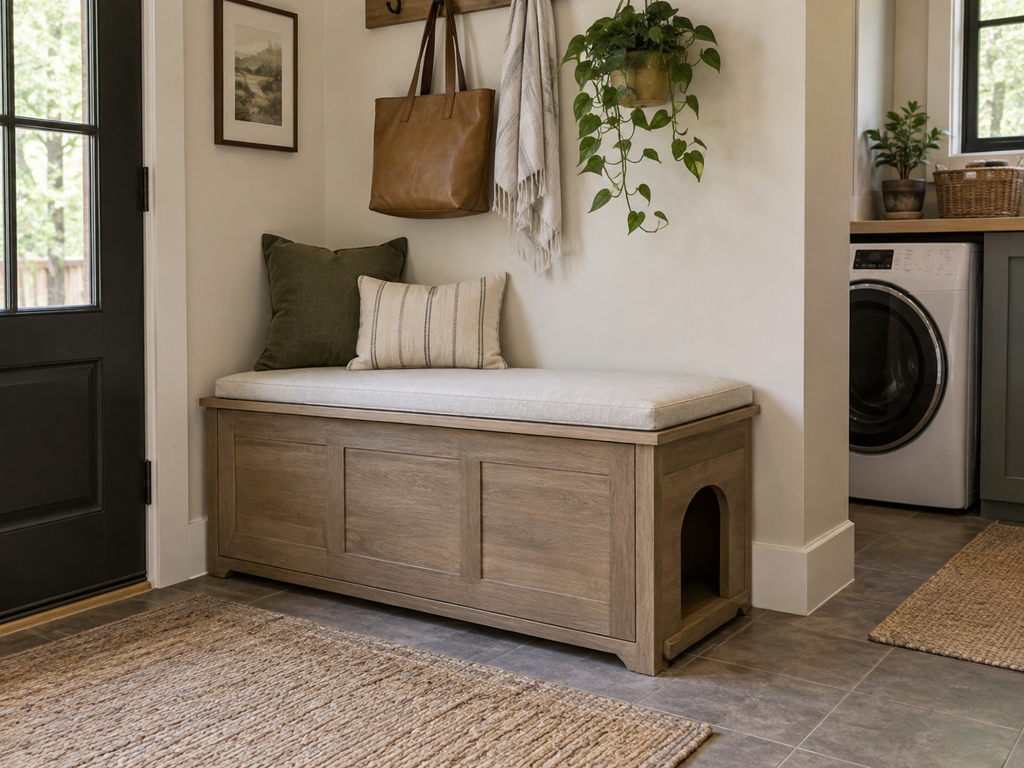
3. Bench-Style Hidden Litter Box
Best for: entryways, mudrooms, laundry rooms and wider hallway spaces
A bench-style enclosure can work well when you have more horizontal wall space and want the litter box to blend into furniture that already makes sense in the room.
These setups can be especially useful near an entryway or laundry area because the longer shape often gives you more interior room than a compact end-table enclosure.
Why it can work well
A bench-style design can offer a nice balance between appearance and usable space. Depending on the layout, it may give you enough room for a larger litter tray while still providing a surface for baskets, shoes, bags or other everyday items.
Some designs also create a little extra distance between the litter box and the outer entrance, which may help contain scattered litter.
What to watch for
The extra width can be helpful, but it does not automatically mean the litter compartment itself is large.
Check:
- the actual dimensions of the litter-box compartment
- whether a divider takes away too much usable space
- whether the cat entrance is on the side you need for your room layout
- whether the top is designed to support sitting or only light storage
- whether the inside is easy to access for cleaning
If the unit is marketed as a “bench,” verify that it is actually rated for the weight of a person before using it as seating.
One More Search tip
Think about the room layout before buying. A side-entry enclosure can be great in one space and awkward in another if the cat opening ends up facing a wall or blocking a walkway.
4. Extra-Large Enclosure for a Jumbo Box
Best for: large cats, jumbo litter trays and bulky automatic boxes
If your cat uses a large or jumbo litter box, this is the category where measuring becomes especially important. A cabinet can look enormous in a product photo but still have surprisingly little usable space once you account for walls, doors, drawers and dividers.
A good extra-large enclosure gives the litter tray enough room without forcing you to downsize the box just to make the furniture work.
Why it can work well
This style makes the most sense when you already know your cat prefers a larger litter box or when you use an oversized or automatic model.
For example, The Refined Feline currently lists its Extra-Large Refined Litter Box Deluxe with 31 inches of internal width, 21 inches of internal depth and 20.5 inches of internal height. The manufacturer also includes ventilation slots that can accept carbon filters and says the Extra-Large version fits several automatic litter-box models.
That is the kind of information worth looking for: actual internal dimensions, not simply a product labeled “XL.”
What to watch for
Some products advertise only their exterior measurements. Others have removable dividers or storage compartments that dramatically change the space available for the litter tray.
Before buying, check:
- the exact internal dimensions
- whether drawers or dividers reduce usable space
- the height of the cat entrance
- whether your existing litter box can be removed easily for cleaning
- whether there is enough airflow around a larger box
Also check the specific automatic litter box you own rather than assuming “XL” means every machine will fit.
One More Search tip
If a listing gives you only the outside dimensions, keep searching until you find the inside dimensions. For litter-box furniture, the measurement your cat actually gets to use matters far more than the size of the cabinet sitting in your room.
5. Double-Compartment Enclosure
Best for: containing litter mess, separating a tray from supplies, or fitting two boxes into one piece of furniture
Double-compartment enclosures usually have two interior sections separated by a divider or corridor. Depending on the design, you can use both sides for litter boxes, use one side for the box and the other for storage or tracking control, or remove the divider to create a larger interior.
Current products vary quite a bit. For example, HOOBRO sells a double-cabin model that is about 58.3 inches wide with two enclosed compartments, while a Tucker Murphy Pet model lists two compartments of roughly 22.4 × 17.7 × 17.7 inches each. That is exactly why checking the individual compartment size matters more than seeing the words “double” or “for two cats” in the product title.
Why it can work well
The extra compartment can help keep litter from being kicked directly onto the floor, and some designs create a short interior pathway before the cat exits the furniture.
It can also be useful if you want to keep a scoop, litter mat, waste bags or other supplies hidden inside the same piece of furniture.
What to watch for
A double-compartment cabinet does not automatically mean two comfortable litter-box spaces.
Check:
- the dimensions of each individual compartment
- whether the divider can be removed
- whether both trays can actually be removed easily for cleaning
- whether cats have more than one way to enter or exit
- whether the divider creates a cramped passageway
- whether ventilation is adequate on both sides
Most importantly, if you have multiple cats, don’t assume that putting two litter boxes side-by-side inside one cabinet replaces the need for boxes in separate locations. Cats can treat adjacent boxes as one toileting area, and guidance for multi-cat homes generally favors multiple litter-box locations around the home.
One More Search tip
Treat “holds two litter boxes” as a furniture feature, not a complete multi-cat litter-box plan. The cabinet may be convenient, but your cats may still benefit from another box somewhere else in the house.
6. DIY or Repurposed Furniture Setup
Best for: budget-conscious shoppers, awkward spaces and people who want a custom fit
You do not necessarily need to buy furniture marketed specifically as a litter-box enclosure. A cabinet, bench, storage console or other piece of furniture can sometimes be repurposed to hide a litter box — especially if you need dimensions that off-the-shelf pet furniture does not offer.
Why it can work well
DIY gives you control over the two measurements that matter most: the litter box you already use and the space you actually have available.
It can also be cheaper than buying specialty pet furniture, particularly if you already own a cabinet that could be modified.
What to watch for
A repurposed cabinet still needs to function safely and comfortably for the cat.
Check:
- whether there is enough interior room around the litter tray
- whether the entrance is large enough and positioned conveniently
- whether you can add ventilation without weakening the furniture
- whether the interior surface can be wiped clean
- whether exposed cut edges are smooth and safe
- whether doors, hinges or hardware could pinch or trap a cat
- whether the cabinet remains stable after cutting an opening into it
Avoid creating a sealed box simply because it hides odors from the room. Trapping odors inside may make the enclosure less appealing to the cat.
If the furniture uses particleboard or other absorbent material, consider protecting vulnerable interior surfaces from moisture and urine so the enclosure does not become difficult to clean over time.
One More Search tip
Start with the litter box and the cat, then design the furniture around them. DIY is most useful when it solves a sizing or layout problem — not when it simply makes an attractive cabinet harder for the cat to use.
7. Partially Hidden or Open-Air Setup
Best for: cats that dislike enclosed boxes, easy cleaning and homes where you only need to reduce the visual impact
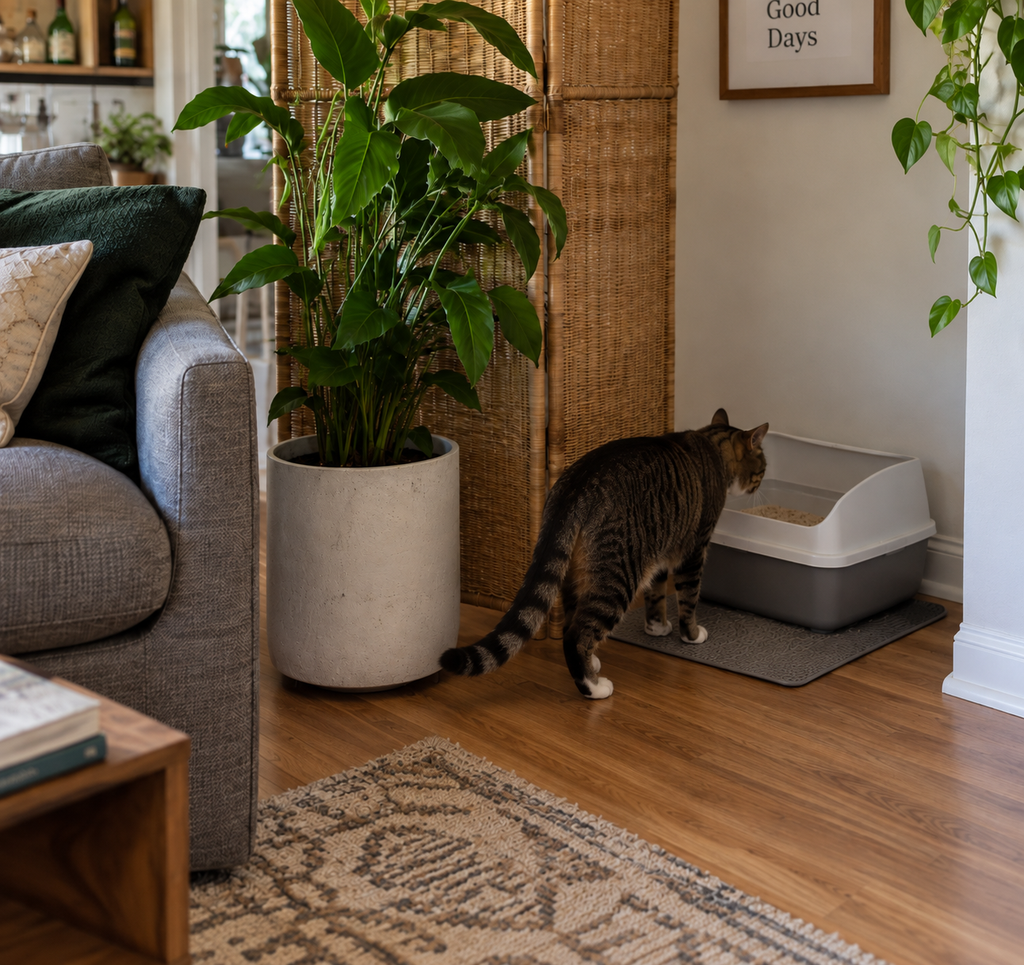
Not every litter box needs to disappear inside a cabinet. Sometimes the better solution is to screen it from view without fully enclosing it.
That might mean placing the box behind a decorative room divider, beside a console table, underneath an open bench, inside a partially open nook, or simply positioning furniture so the box is less visible from the main part of the room.
Why it can work well
You still get some visual separation without trapping the cat inside a small enclosed space.
That can be important because veterinary guidance generally favors large, uncovered litter boxes in quiet but accessible locations, and many cats prefer an open box over a covered one. Covered boxes can also retain odors if cleaning slips.
An open-air setup also makes it easier to:
- use a larger litter tray
- scoop without opening cabinet doors
- see immediately when the box needs cleaning
- provide easier access for kittens, older cats or cats with mobility issues
- change the layout if your cat seems uncomfortable
What to watch for
You still want enough privacy that the cat is not using the box in the middle of a busy walkway or next to loud appliances.
Also make sure the “hidden” setup does not create a dead-end where another pet or cat could block the exit.
A decorative screen that looks great to you is not useful if it makes the litter box harder for the cat to approach or leave.
One More Search tip
Sometimes the best hidden litter box is only hidden from people. If you can make the area look better without enclosing the cat at all, that may be the simpler solution.
A Few Real Litter Box Enclosures to Compare
These aren’t automatically the “best” choices for every cat or every home. They’re useful examples because they show how different enclosure styles solve different problems — and why checking the measurements matters before buying.
FEANDREA Barn Door End Table — budget-friendly compact option
This is the type of smaller enclosure that works when you want the litter box to double as an end table. Chewy currently lists it around $56-$80, pricing varies by size and finish, so check the current listing. The tradeoff is exactly what we discussed above: compact furniture generally means less interior room, so measure your litter tray carefully before choosing it.
Unipaws Jumbo Enclosure — for larger or automatic boxes
This model is aimed at shoppers who need substantially more space and is currently around $200 at Chewy. Unipaws markets the jumbo version for many self-cleaning and automatic litter boxes, making it the kind of enclosure worth investigating when a standard cabinet is simply too small.
The Refined Feline Extra-Large — premium furniture-style option
This is much more expensive, but it illustrates what a larger purpose-built cabinet can offer. The XL model has an interior around 31 inches long, 21 inches wide and 20.5 inches high, according to Chewy’s product information.
New Age Pet ECOFLEX Freedom Litter Loo — moisture-resistant alternative
Most enclosure furniture is made from engineered wood, which makes moisture worth thinking about. The ECOFLEX model uses a composite material designed to resist moisture and odor, making it an interesting alternative for shoppers who are more concerned about cleanability than a traditional furniture look.
The important takeaway isn’t that one of these is the universal winner. The right enclosure starts with the litter box your cat is already comfortable using, then works backward to furniture that actually fits it.
Which Hidden Litter Box Style Makes the Most Sense?
The best option depends less on which enclosure looks nicest and more on the problem you’re trying to solve.
Choose a sideboard-style cabinet if appearance matters most and the litter box has to live in a main living area.
Choose an end-table enclosure if floor space is limited and you need the furniture to serve more than one purpose.
Choose a bench-style enclosure if you have more wall space and want additional room for a larger litter tray or storage.
Choose an extra-large enclosure if you already use a jumbo or automatic litter box. Measure the actual interior carefully before buying.
Consider a double-compartment design if litter tracking or hidden storage is a priority, but don’t assume two boxes inside one cabinet replace separate litter-box locations in a multi-cat home.
Go DIY if standard furniture doesn’t fit your space, your litter box or your budget.
Stick with a partially hidden open setup if your cat prefers an uncovered box or if easy access and cleaning matter more than completely concealing it.
In other words, start with your cat, your litter box and your room—then find the furniture that fits those requirements.
Before You Buy
Hidden litter box furniture can make a big difference in how a litter-box area looks, but the best-looking option isn’t necessarily the best one to live with.
Before ordering anything, measure your existing litter box, check the usable interior dimensions, think about ventilation and cleaning access, and make sure the setup still gives your cat enough room to use the box comfortably.
A few extra minutes of research now can save you from assembling a piece of furniture only to discover that the litter box barely fits—or your cat wants nothing to do with it.
Before you buy, do one more search.