
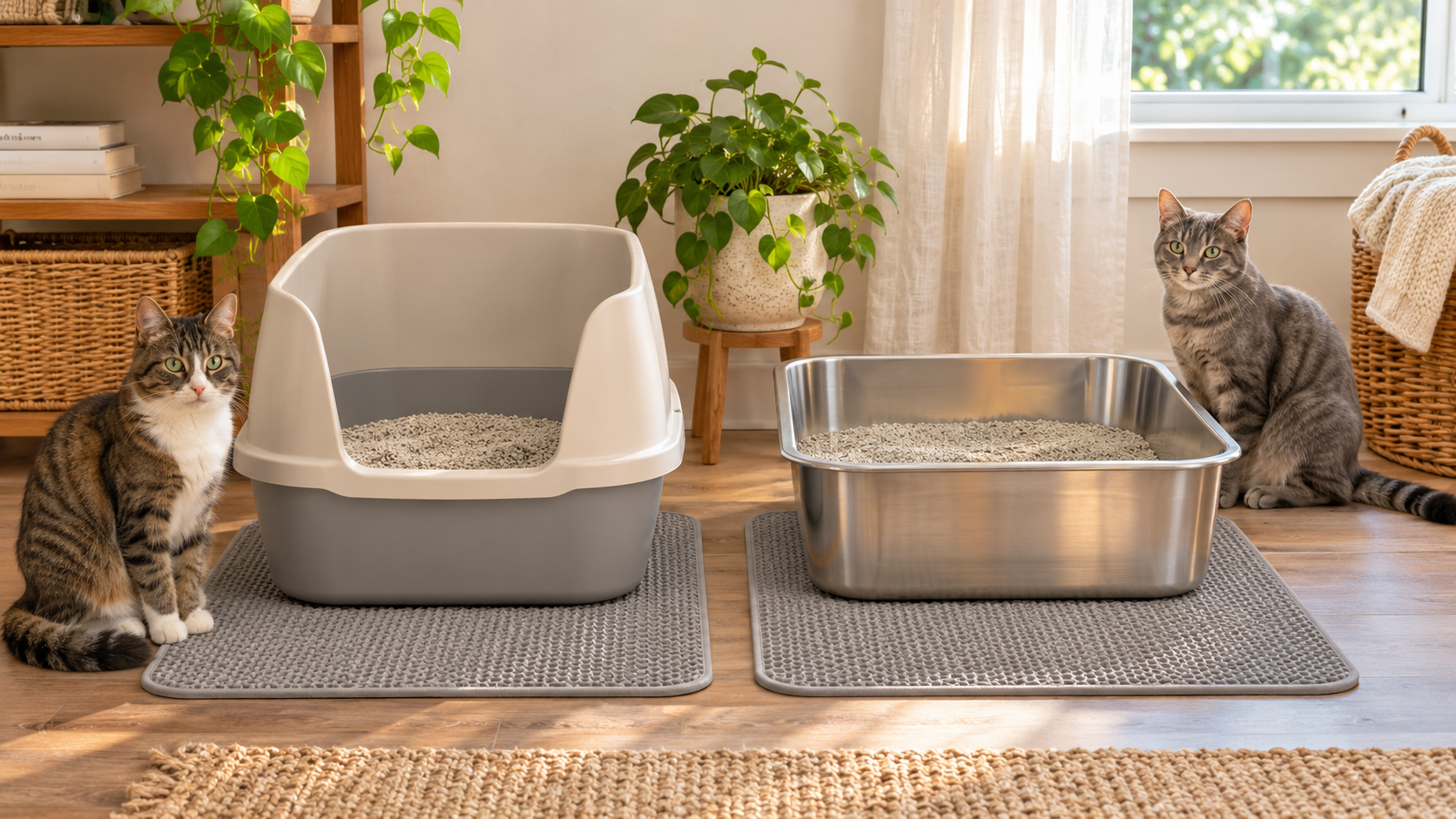
Stainless steel litter boxes get promoted as the upgrade from plastic: easier to clean, less likely to hold onto odor, and built to last. After using high-sided plastic boxes and then switching to two different stainless setups in our own house, our takeaway is a little less absolute.
Stainless steel can be a worthwhile upgrade—but the material alone does not make a litter box better. Size, entry height, location, high sides or covers, and how easy the box is to clean in the space where you actually use it can matter just as much.
In our house, both stainless boxes have been easy to clean. But the larger enclosed box downstairs feels noticeably roomier than the smaller high-sided box we chose for the tighter laundry-room space. That experience is a good example of why we would not automatically replace a roomy plastic box with a smaller stainless one just because it is metal.
Short version: If your current plastic box is scratched, holding onto odor, or becoming difficult to clean, stainless steel is worth considering. If your plastic box is roomy, accessible, and still working well, there may be no urgent reason to replace it.
[IMAGE SLOT 1 — HERO: Illustrative side-by-side comparison of a high-sided plastic litter box and stainless-steel litter box. Do not depict exact Amazon products.]
Stainless Steel vs. Plastic at a Glance
| What matters | Stainless steel | Plastic |
|---|---|---|
| Cleaning surface | Smooth, rigid surface that has been easy to clean in our experience | Also easy to clean when new and in good condition |
| Odor retention over time | Stainless steel does not retain odors the way plastic can over time | Plastic can eventually retain odor as it ages |
| Scratch resistance | Harder surface than plastic | Can become scratched with use |
| Sizes and shapes | More choices than there used to be, but still fewer options | Huge range of sizes, entry heights, covers, rims and shapes |
| Weight | Usually heavier | Usually lighter and easier to move |
| Best reason to choose it | You want a durable, easy-cleaning tray | You need a specific size, shape, entry height or lighter box |
Veterinary guidance backs up the idea that material is only part of the decision. Cornell and the Feline Veterinary Medical Association emphasize adequate box size, easy access, cleanliness, location and individual cat preferences. Merck Animal Health specifically notes that plastic can retain odor over time while stainless steel does not.
What Actually Improved When We Switched to Stainless Steel
The clearest improvement for us has been simple: both of our stainless trays have been easy to clean.
We currently use two different stainless setups. One is a larger enclosed Tevila box downstairs. The other is a more compact FURTIME high-sided box in our laundry room.
We intentionally chose the smaller box for the laundry room because the available space is tighter. It does feel more confined than the larger box downstairs, but that is the tradeoff that allows it to fit where we need it.
That distinction matters. The stainless material did not magically make the smaller box roomier. It gave us an easy-cleaning tray in a footprint that worked for that location.
.
What Stainless Steel Does Not Fix
A stainless tray will not compensate for a box that is too small, awkward to enter, badly located or not cleaned often enough.
Cat-behavior guidance generally recommends giving cats enough space to enter, turn around and dig comfortably. Feline veterinary guidance commonly suggests a box roughly one-and-a-half times the cat’s body length when possible. Kittens, older cats and cats with mobility problems may also need a lower entry.
This is why we would choose a sufficiently large plastic box over an undersized stainless one. The best material in the wrong size is still the wrong box.
If you are trying to decide where to put the box—or whether hiding it inside furniture will create another problem—our hidden litter box guide covers location, access and enclosure tradeoffs in more detail.
Does Stainless Steel Actually Help With Litter Box Odor?
This is where we would be careful with the marketing claims.
Merck Animal Health notes that plastic litter boxes can retain odor as they age, while stainless steel does not retain odor in the same way. That gives stainless a real material advantage if an older plastic box itself has started to smell.
But the box material does not make fresh waste odor disappear.
We use Dr. Elsey’s Ultra Unscented Clumping Clay litter in our boxes. In our household it clumps well and can be somewhat dusty. We still notice some odor right around the box when cleaning it, but it has not been a broader room-wide odor problem.
That is why we would look at stainless as one part of odor management, not the entire solution. Scooping, litter choice, cleaning and placement still matter. If odor is the main problem you are trying to solve, see our full guide to keeping a litter box from smelling.
One Thing We Stopped Using: Plastic Litter Box Liners
We also tried plastic litter-box liners before switching away from them.
In theory, a liner sounds convenient: pull it out with the old litter and start fresh. In our house, our cat would scratch and tear through the liner during normal litter-box use. That made changing the litter more cumbersome instead of easier, so we stopped using them.
That experience is not universal—some cats and households may do fine with liners—but it is another reason we appreciate having a tray that is easy to clean directly. Cornell also notes that while liners can help keep a box cleaner, many cats do not like them.
Our Three Real-World Box Examples
The comparison below is useful because these are not three nearly identical boxes chosen only for an article. They represent the kinds of tradeoffs we have actually dealt with at home.
| Box | Approx. listed size | Style | Why it matters |
|---|---|---|---|
| ExquisiCat X-Large high-sided plastic style | 23 × 17.1 × 10.8 in. | Plastic, open top, removable high rim | Shows how plastic can provide a roomy footprint and high sides |
| FURTIME Large | 19 × 14 × 9 in. | Stainless lower pan with high-sided surround | Fits our tighter laundry-room space and has been easy to clean |
| Tevila XL Enclosed | 23.62 × 15.74 × 15.74 in. | Stainless lower tray with enclosed surround | Our roomier downstairs setup; also easy to clean |
Note: Listed dimensions are useful for comparing overall footprint, but they do not necessarily equal the usable interior floor area. Covers, rims and wall shapes can reduce the space the cat actually has inside.
Two Stainless Boxes We Actually Use
Affiliate disclosure: As an Amazon Associate, One More Search earns from qualifying purchases. The two Amazon products below are boxes we actually purchased for our own home.
Tevila XL Enclosed Stainless Steel Litter Box — Our Roomier Setup
The Tevila XL is the larger enclosed stainless setup we keep downstairs. Of our two stainless boxes, this is the one that feels roomier in everyday use.
The current listing shows an overall size of approximately 23.62 inches long by 15.74 inches wide by 15.74 inches high. The stainless tray sits underneath an enclosed high-sided surround.
Why we like it: It has been easy to clean, gives the cat more room than our smaller laundry-room box, and the enclosure helps contain the litter-box area.
What to consider: The enclosure makes the overall box larger, so measure the space where you plan to put it. Also remember that the outside dimensions do not tell you the exact usable floor space inside.
.
FURTIME Large Stainless Litter Box — Better for Our Smaller Space
Our FURTIME box lives in the laundry room, where the available space is much tighter. We intentionally went with the smaller footprint rather than trying to squeeze a larger box into the area.
The Large version we purchased is listed at approximately 19 inches long by 14 inches wide by 9 inches high, with a stainless lower pan and high-sided surround.
Why we like it: It fits the space we had available and, like the Tevila, has been easy to clean.
What to consider: It naturally feels more confined than the larger downstairs box. That does not make it a bad box—it simply illustrates why you should measure both the room and the space your cat will have before deciding that stainless is automatically an upgrade.
Plastic Can Still Be the Better Choice
Before switching to stainless, we used high-sided plastic ExquisiCat boxes with a removable upper rim. The current X-Large version of that style is listed at 23 by 17.1 by 10.8 inches—wider than either of our stainless examples.
That is exactly why we would not dismiss plastic.
- Plastic gives you many more shapes and footprints to choose from.
- It is usually lighter when you need to move or wash the box.
- Low-entry options are easier to find for kittens, senior cats or cats with mobility limitations.
- A large plastic box may offer more usable room than a smaller stainless alternative.
If your current plastic box is big enough, still cleans up well and is not holding onto odor, keeping it may be the smarter decision.
When We Think Stainless Steel Is Worth the Upgrade
- Your plastic box itself has started holding onto odor.
- The surface is scratched or becoming harder to clean.
- You can get a stainless box that is still large and accessible enough for your cat.
- You want to clean the tray directly instead of relying on liners.
- You are comfortable with the extra weight and the available footprint.
When We Would Keep the Plastic Box
- Your existing box is roomy, clean and working well.
- The stainless option would force you into a noticeably smaller box.
- Your cat needs a particularly low entry or unusual shape.
- You frequently move the box and value lighter weight.
- You are switching only because stainless is being marketed as universally better.
Our Verdict
We like our stainless litter boxes, but we would not tell everyone with a plastic box to replace it.
For us, the biggest practical benefit has been having trays that are easy to clean. But using two different stainless boxes has also reinforced that size and location still drive the decision. Our larger downstairs box feels roomier; our smaller laundry-room box works because it fits a tighter space.
If your plastic box is scratched, retaining odor or becoming unpleasant to clean, stainless steel is a reasonable upgrade. If your plastic box already gives your cat plenty of room and works well, the material alone may not justify replacing it.
Measure first. Choose the box that works for your cat and your space second. Then decide whether stainless steel actually improves anything that matters.
Frequently Asked Questions
Are stainless steel litter boxes actually better than plastic?
They can be better for durability, cleaning and avoiding odor retention in the box material itself. But a large, accessible plastic box can still be a better choice than a stainless box that is too small or difficult for the cat to use.
Do stainless steel litter boxes eliminate odor?
No. Stainless steel does not retain odor the way aging plastic can, but fresh litter-box waste can still smell. Regular scooping, cleaning, litter choice and placement still matter.
Do you need a liner with a stainless steel litter box?
We do not use liners with ours. We previously tried plastic liners, but our cat scratched and tore them during normal use, which made litter changes more cumbersome. Other cats and households may have a different experience.
What matters more: litter box material or size?
If forced to choose, we would prioritize enough usable space and easy access over material. Veterinary guidance emphasizes giving cats a box large enough to move and turn around comfortably.
Should I replace a plastic litter box just because it is plastic?
Not necessarily. If it is roomy, clean, accessible and not retaining odor, there may be no practical reason to replace it yet.